
By Eyo Charles
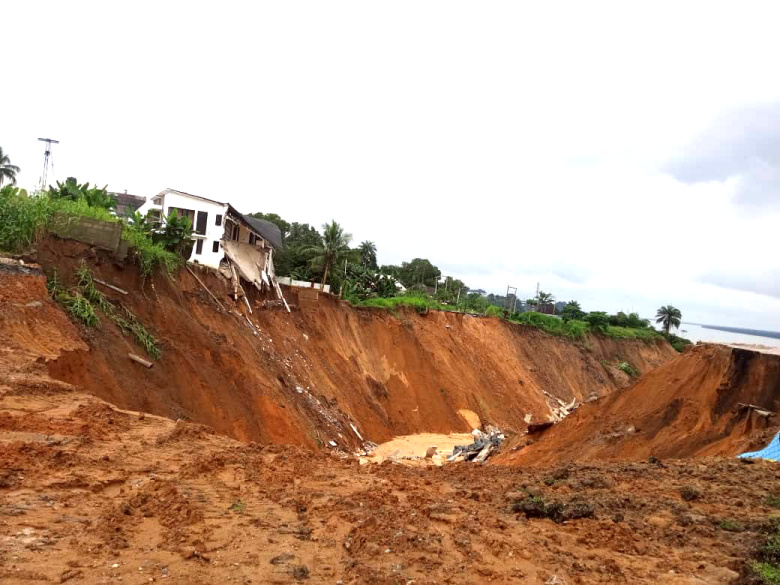
Two forces of nature and one human-driven activity are combining to wreak havoc across Cross River State in a scale that has never been witnessed before. These are the combined forces of landslides, erosion and illegal mining.
In the coastal city of Calabar and several communities across the state, the consequences have been devastating in recent months, with families losing loved ones, homes and livelihoods, while roads, farmlands and other critical infrastructure have suffered extensive damage.
The human cost has been particularly painful.
According to the International Federation of Red Cross and Red Crescent Societies (IFRC), about 10 people have reportedly died in Cross River in incidents linked to floods, landslides and abandoned mining pits.
Among the victims were the four children of Mr Kingsley Etim, who died alongside another adult during a flood disaster at Ikot Anwatim, Calabar Municipality, last month.
Etim also lost his house in the disaster, while two other houses were destroyed and two people were critically injured. For Etim and his wife, Mrs Mercy Edu, the tragedy has left a wound that monetary compensation alone may not heal.
“I watched everything I loved, cherished and treasured disappear within the blink of an eye,” Mercy lamented, adding “No amount of money or material compensation can bring back my four children. They were my hope in this uncertain world.”
Appealing for assistance, she added: “I need a place to live. I need treatment for my heart and my mind. I need help to start a small business so that I will not beg.”
She also appealed to the government to address the hills and ravines around Ikot Anwatim before other families suffer a similar fate.
The Etim family tragedy mirrors the experiences of many other residents of Calabar and surrounding communities who have watched helplessly as erosion, flooding and landslides destroy their homes and means of livelihood.
When the Earth Gives Way
For centuries, some traditionalists in Calabar have attributed environmental disasters to the Anansa deity, worshipped in parts of the Efik kingdom, arguing that she has not been adequately appeased.
One local chieftain, Akabom Asuquo, said: “We’ve never experienced this type of anger from Anansa, our water goddess. These devastations are as a result of her fury over persistent neglect by custodians and authorities.”
But the Acting Chairman of the Obutong Traditional Council, His Royal Highness Iso Archibong, described the Obutong landslide as a natural disaster rather than the fault of the government or a consequence of failure to appease the Anansa deity.
The Supervisor for Environment in Calabar Municipality, Mr Eso Eso Archibong, also confirmed that the landslide was a natural disaster.
He appealed to the Federal Government, development partners and humanitarian organisations to urgently assist the affected communities, noting that the scale of destruction was unprecedented.
Environmental experts and authorities have pointed to more conventional explanations, including climate change, intense rainfall, changing weather patterns, poor drainage, unplanned development and inadequate responses to early warning signs.
Whatever the explanation, the impact has been unmistakable.
Among the areas in Calabar recently hit by severe mudslides and landslides are Marina, or Anansa Road, in Obutong, Boro Pit, Satellite Town and Edim Otop.
Several houses, businesses and other properties worth hundreds of millions of naira have reportedly been destroyed or swept away, while roads and adjoining areas have suffered severe damage.
In Obutong, the collapse of an underground drainage channel along Marina Road has been cited as a possible trigger of the major landslide that affected the community.
The danger is not confined to Calabar.
In neighbouring Akpabuyo Local Government Area, fresh concerns have emerged over worsening gully erosion at Ikot Asuquo Edem, where residents fear that the only federal highway linking Bakassi Local Government Area could eventually be cut off if urgent intervention is not undertaken.
The Leader of the Bakassi Legislative Council, Grace Bassey, warned that the erosion had continued to encroach on sections of the highway, threatening lives and critical infrastructure.
A resident, Okon Etim, described the situation as frightening, saying motorists and commuters were increasingly afraid to use the road.
“We use this road every day to transport goods and travel to Calabar and Bakassi. But the erosion keeps expanding whenever it rains. The government and the relevant agencies should intervene quickly before the road is cut off completely,” he said.
Communities Under Water and Mud
Prolonged heavy rainfall, windstorms and landslides in July and August affected several communities across Calabar and its environs.
At Ikot Effanga, along Old Odukpani Road, a building collapsed on August 28 after earth and refuse from an elevated area gave way.
Two of the three tenants reportedly died, while other houses below the ravine remain threatened.
In Ekorinim II, beside Lords Academy, severe flooding caused by a blocked drainage channel affected five residential buildings and displaced more than 15 households.
At the Federal Housing Estate, floodwaters brought down a perimeter fence and affected residential structures, with two buildings occupied by four households reportedly impacted.
The Big Qua area also recorded flooding that damaged fences and residential properties, affecting several residents and property owners.
A one-month-old baby was reportedly swept away by floodwaters in the area.
On Atu, Goldie Street and Target Street in Calabar South Local Government Area, blocked drainage channels and damaged waterways have contributed to recurrent flooding, exposing residents and properties to continuing risks during periods of heavy rainfall.
For many affected families, the disasters have meant not only the loss of homes and property, but also the destruction of businesses, farmlands and other sources of income.
The Price of Recovery
Following the ecological disasters recorded in July and August, the Cross River State Government has approached the UNCCD COP17 in Mongolia, seeking $25 million for recovery and ecological restoration.
The state government has, however, clarified that the $25 million figure is an advocacy and planning target, not a final valuation of the damage suffered. A comprehensive technical assessment is still required to determine the actual cost of the devastation.
The proposed $25 million recovery package is broken down into $3 million for humanitarian protection, shelter, WASH and household recovery; $6 million for slope stabilisation, drainage and erosion control; $4 million for risk mapping, geotechnical and hydrological studies and early warning systems; $6 million for watershed, forest, wetland and ecological restoration; $4 million for resilient infrastructure and livelihood recovery; and $2 million for programme management, monitoring and contingency.
But while the government seeks international support to repair the damage already done, another danger is quietly deepening across the state’s forests and mineral-rich communities.
That danger is illegal mining.
The Mining Frontier
Illegal mining has been reported in several local government areas of Cross River, where deposits of gold, uranium, limestone, gemstones and other minerals have been discovered.
Areas affected or identified as having mining activities include Biase, Yakurr, Akamkpa, Boki, Odukpani and Abi.
The activities have raised concerns not only about revenue losses but also about deforestation, pollution, insecurity and the destruction of fragile ecosystems.
In some forest communities, large numbers of miners have reportedly moved into mineral-rich areas, sometimes accompanied by armed groups or private security personnel.
There have also been allegations that some traditional and community leaders have been compromised to facilitate access to mineral-rich forests. Such allegations, however, require verification on a case-by-case basis.
The conflict between mining activities and environmental protection recently came into sharp focus in Etung Local Government Area.
The Special Anti-Poaching Squad of the Cross River National Park arrested 17 suspected illegal miners operating around the Ekuri Eyenyen and Etara communities.
The Conservator of Parks, CP Joseph Ntui Assam, said the arrests followed actionable intelligence, warning that illegal mining and other prohibited activities within the park posed serious environmental and security threats.
Assam said mining, hunting, logging, farm encroachment and water poisoning were prohibited within the National Park, adding that the activities had degraded the land, polluted water sources and endangered the health and livelihoods of surrounding communities.
“Most of the streams and agricultural lands around Etara and Ekuri Eyenyen are polluted. The people don’t have good sources of drinking water,” he said.
But beyond the arrests, the Conservator raised another troubling issue: the alleged issuance of mining licences that overlap with protected areas of the Cross River National Park.
He alleged that the Mining Cadastre Office in Abuja and the Federal Mines Office in Calabar had, in some instances, issued licences or approvals covering areas within the park, describing such occurrences as a violation of laws protecting the reserve.
The case of B4Live Integrated Services, registered by Ekpo Mbang Eno, subsequently emerged at the centre of the dispute, with the company linked to mining activities in the affected area.
The Cross River Commissioner for Mineral Resources, Effiom-Ekaha Otu, confirmed that B4Live had been profiled by the state ministry and licensed by the Federal Government. He, however, acknowledged that its mining lease could have overlapped a reserved area.
According to Otu, where such an overlap occurred, the Mining Cadastre Office should be responsible for correcting the boundaries rather than automatically branding the licence holder an illegal miner.
The Federal Mines Officer in Cross River, Engr. Ayelabola Olubunmi, also acknowledged that mining licences could inadvertently overlap protected areas, saying the National Park had previously brought such cases to the office’s attention.
Eno denied hiring the 17 arrested miners to illegally operate inside the park. He said he had hired 40 miners and 10 supervisors and obtained community consent, adding that rangers initially encountered 67 people at the site.
According to him, community leaders identified 50 persons who had approval to prospect in the area, while others had accompanied them.
He maintained that he was properly licensed and unaware that the approved mining area extended into a restricted zone.
The controversy has therefore gone beyond the arrest of miners. It has raised broader questions about the regulation of mining activities, the accuracy of cadastral boundaries and the possibility of overlaps between federally issued mining leases and protected areas.
Stakeholders have urged the Mining Cadastre Office in Abuja and the Federal Mines Office in Calabar to conduct proper boundary checks before issuing licences, warning that regulatory lapses could fuel illegal mining, environmental degradation and conflict between miners and law-enforcement agencies.
Government Moves Against Illegal Miners
The Federal Mines Officer in Cross River State, Engr. Ayelabola Olubunmi, has warned that the Federal Government will intensify its clampdown on illegal mining operations across the state.
He said the government was losing millions of naira in revenue to illegal mining, alleging that undocumented firms were operating in forest communities across Cross River.
Olubunmi spoke during a fact-finding meeting with traditional leaders and other stakeholders in Butatong, Boki Local Government Area, following reports of an influx of foreigners and private militia into communities around the Okwango Division of the Cross River National Park.
He said several mining operators were active in Okwa Villages 1 and 2, enclaves within the Cross River National Park and adjoining Butatong, without the knowledge or approval of the Federal Ministry of Solid Minerals.
“There are a lot of mining persons in Okwa Villages 1 and 2, which are enclaves in the CRNP, adjoining Butatong. These firms are not known to the Federal Ministry of Solid Minerals and they do not go through legal procedures, thereby denying the Federal Government its due royalties,” he said.
“We don’t want firms to enter our forests for mining activities through the backdoor. We’ll definitely fish them out,” he added.
Olubunmi said the ministry would intensify sensitisation and enforcement visits to affected communities.
He also warned traditional rulers and community leaders against granting mining consent on the strength of fake or unapproved documents, saying the ministry had officially licensed firms authorised to operate in designated areas of the state.
According to him, the government needs mining companies that can be held accountable for their activities, unlike illegal operators who exploit community resources without providing corresponding benefits to affected communities.
Olubunmi said illegal mining could also trigger social conflicts while accelerating deforestation and environmental degradation.
“Mining activities must be in line with the Minerals and Mining Act of 2007,” he emphasised, warning illegal miners and those aiding their activities that the government would treat their operations as economic sabotage.
He called on residents to remain vigilant and report mining activities that could expose communities to environmental, health and security risks.
He further disclosed that the Mines Office would collaborate with the National Park Service, the Department of State Services and the Nigeria Security and Civil Defence Corps to inspect mining sites and verify compliance with licences, approvals and other regulatory requirements.
At Butatong, the Clan Head, HRH Otu Gregory Apah, urged indigenes not to harbour illegal miners and appealed to the government to provide basic social amenities to the mineral-rich community.
he Chairman of Butatong Community Council, Benedict Apah, and Chief Denis Osor said they were not aware of mineral deposits in Butatong itself but confirmed that mining activities were ongoing in neighbouring enclave communities, including Okwango, Okwa 1, Okwa 2 and Bumagi.
They also expressed concern over the influx of foreigners, alleging that some arrive with arms and mining equipment, which they said could pose a security threat to residents.
A Forest Under Pressure
The scale of environmental degradation becomes even clearer when the state’s forest cover is considered.
The state’s COP17 evidence note says Cross River lost approximately 134,000 hectares of tree cover between 2001 and 2023.
It links forest loss and land degradation to reduced watershed and slope resilience, while identifying unplanned development, excavation, blocked drainage and poor waste disposal as factors capable of intensifying runoff and flooding.
The National Park Service’s Conservator-General was also reportedly quoted in July as saying that 14,000 hectares of Cross River’s tropical rainforest were destroyed in 2025 through logging, illegal mining and uncontrolled agricultural activities.
Taken together, the figures paint a disturbing picture.
From the hills and ravines of Calabar to the erosion-threatened roads of Akpabuyo, from flooded homes to the mineral-rich forests of Boki and Etung, Cross River is confronting an environmental crisis whose consequences go beyond damaged roads and collapsed buildings.
The immediate victims are the families who lose their homes, loved ones and livelihoods.
But the deeper danger is what happens when forests disappear, drainage systems fail, hillsides become unstable and mining continues without effective regulation.
For Cross River, the challenge is no longer simply how to respond to individual disasters after they occur, it is how to prevent the next landslide, flood, erosion disaster or mining-related environmental crisis before it claims another life.